
2025: A Year of Momentum and Political Action
As we look back on 2025, we are filled with a profound sense of awe.
We are proud of what has been achieved and also the amazing commitment to Jesus and Justice shown by this community.
Creation Care: Holding Power to Account
Prophetic Action for Gaza: Love Demands Action
Te Tiriti: Deepening the Roots
Economic Justice: The Everyone Connected Campaign
Upskilling in the Ministry of Transforming Unjust Structures
The Common Grace Aotearoa community has stood tall and stood up to a strong political tide of injustice in 2025. A government that has sought to strip away the rights of Tangata Whenua, to stay silent during genocide in Gaza, to further reduce protections of our precious environment.
In this landscape, the Common Grace Aotearoa whānau stood tall and kept speaking up.
We were established to equip and organise Christians to transform unjust structures for the common good, and in 2025, you did exactly that. You showed up. From the steps of Parliament to the offices of energy retailers; from the freezing pavement outside ministerial offices to the quiet meeting rooms of local church halls, you were there.
We seek to build a gracious Christian voice speaking up for climate, economic, and Te Tiriti justice. This year, that voice was not just spoken; it was shouted, sung, prayed, and lived out in actions that made headlines in New Zealand and even made mention around the world.
Here is the story of our 2025. This is what you were part of.
Creation Care: Holding Power to Account
This year, the fight for our planet required us to stand firm against a tide of regression. We know that caring for creation is not an optional extra for followers of Jesus; it is a mandate to protect the delicate web of life God entrusted to us.
While we had hoped to see momentum building for climate action, 2025 saw the government take backwards steps that threatened our collective future. We watched as Climate Change and Energy Minister Simon Watts overrode officials’ advice and doubled the number of free carbon credits given to heavy polluters, such as the Tiwai Point Aluminium Smelter. We saw Minister Watts extend government subsidies to industries that should no longer receive them, instead of phasing them out more quickly.
It would have been easy to despair. Instead, our Climate Campaign team got to work.
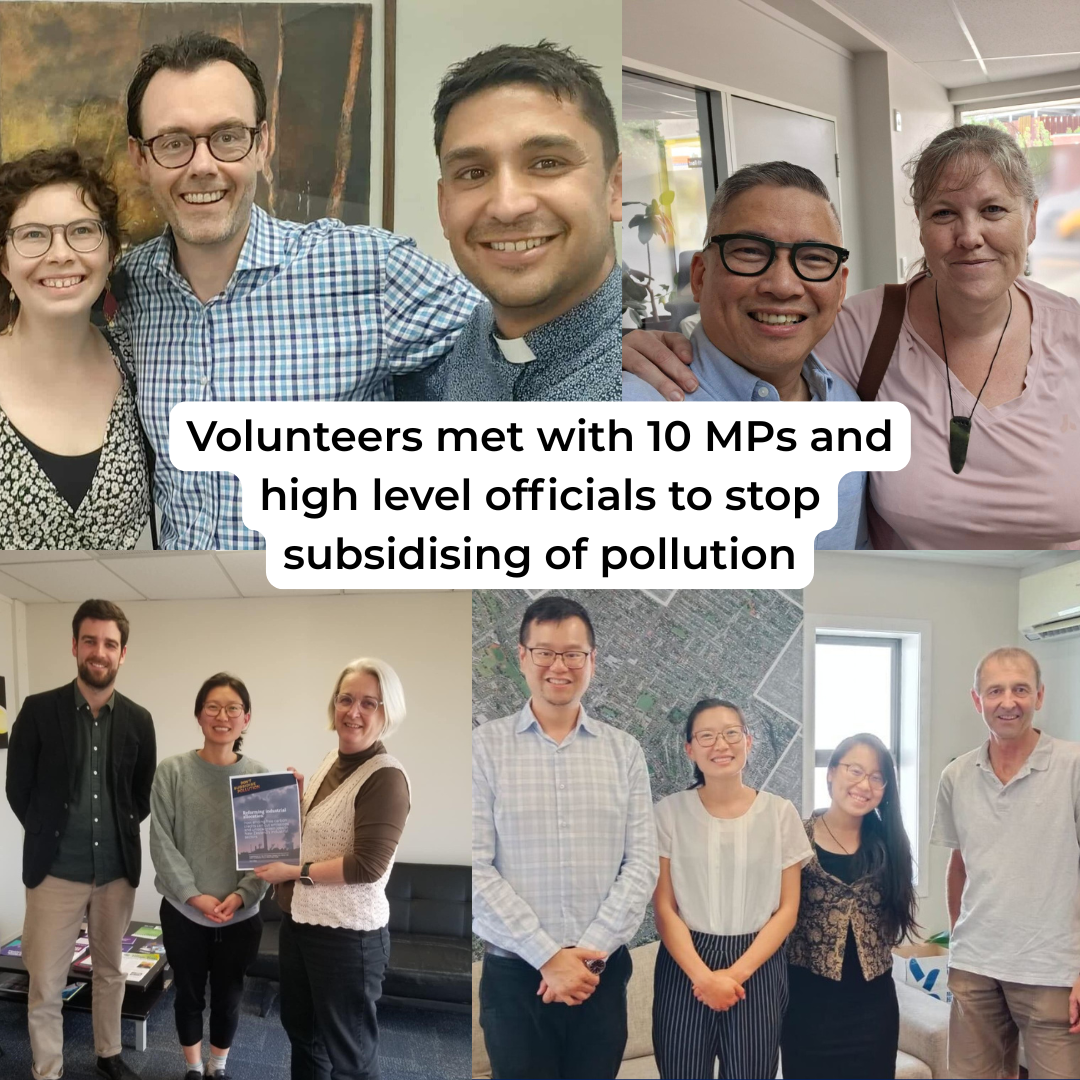
We mobilised. We refused to let these decisions happen in the dark. Our community organised volunteers to hold ten separate high-level meetings with MPs and officials. In these rooms, we spoke truth to power, demanding an end to free carbon credits and challenging the use of public funds for new fossil-fuel infrastructure.
And we saw the fruit of that persistence.
Because of your pressure, we got the Climate Commission to back a review of free carbon credits early in the year, and there are promising signs that the Labour Party will commit to bring forward an end to free carbon credits into their climate policy, building on the commitment we got from the Green Party last year. Ending free carbon credits is a crucial systemic lever that, when pulled, drives some of our biggest polluters towards cleaner alternatives.
We also stood shoulder-to-shoulder with our friends at 350 Aotearoa to fight the construction of a new gas import terminal. In December we helped release an open letter signed by organisations, businesses, and unions, calling on Cabinet to stop wasting taxpayer funds on Liquefied Natural Gas (LNG).
Prophetic Action for Gaza: Love Demands Action
Perhaps nowhere was the Gospel call to solidarity with the oppressed more visible this year than in the suffering of the people of Gaza. In 2025, we were reminded that Christian witness sometimes requires us to put our bodies on the line.
Supporting Aotearoa Christians for Peace in Palestine, we helped organise powerful actions that fit within a long, inspiring tradition of Christian non-violent political action and civil disobedience. We moved beyond words to actions that demanded the world’s attention.
In September, clergy from Anglican, Baptist, and Catholic traditions held vigils and protests at the electorate offices of three senior government ministers. They weren’t there to be nuisance-makers; they were there to draw attention to the urgent moral imperative for the New Zealand government to impose broader and more severe sanctions on Israel to help end the genocide in Gaza.
The imagery was stark and deeply moving. In Wellington, six priests chained themselves together outside Finance Minister Nicola Willis's office. They remained there for 32 hours. Meanwhile, in Auckland, clergy and faith leaders held a sit-in at Health Minister Simeon Brown’s office. Two weeks later, another four clergy stayed overnight outside Immigration Minister Erica Stanford’s office.
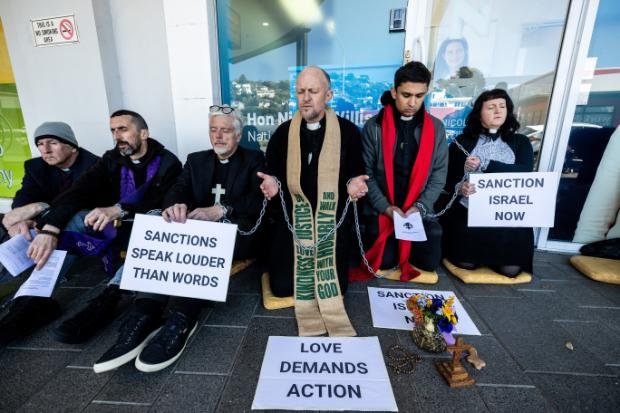
These actions operated under the banner "Love Demands Action".
The protests generated days of sustained media coverage, forcing multiple government ministers to publicly defend their positions on sanctions. The ripple effect went global. The actions were covered by The Guardian and Al Jazeera, with Al Jazeera even questioning Foreign Affairs Minister Winston Peters about the clergy’s protest during a televised interview.
But beyond the headlines, this was a powerful prophetic witness. Throughout the lock-ons, the clergy interacted constantly with members of the public. They invited passersby to join in prayer. They explained, with grace and patience, how their faith in Jesus motivated them to stand with the suffering.
This was the church at its best: visible, sacrificial, and rooted in love. These actions continued a long history of Christian non-violent civil disobedience to call for justice, and we were humbled to support them.
Te Tiriti: Deepening the Roots
Our journey toward honouring Te Tiriti o Waitangi is not a sprint; it is a generational marathon. Last year, we saw a massive surge of interest in our Belonging in this Land course. This year, the work moved from rapid expansion to deepening roots.
While fewer groups ran the course compared to the explosive launch in 2024—39 groups this year compared to 280 previously—the impact remains profoundly positive. Every single one of those 39 groups represents a community of believers wrestling with our history, engaging with the promise of Te Tiriti, and asking what it means to belong in this land as Christians.
We also saw a significant shift in the polling for Māori Wards.
Māori wards are like the Māori seats in parliament, but for local councils. They help ensure that the voice of Tangata Whenua is present around the decision-making table. Therefore, when the government imposed referendums on councils that had already decided they needed Māori wards, it was a move we deeply opposed. We believe that every Māori ward lost is a lost opportunity to embed Māori wisdom and community experiences in council decision-making.
Across the country, 42 local and regional body organisations held referendums on whether to keep a Māori ward. This was an opportunity for the church to mobilise as allies to Tangata Whenua.
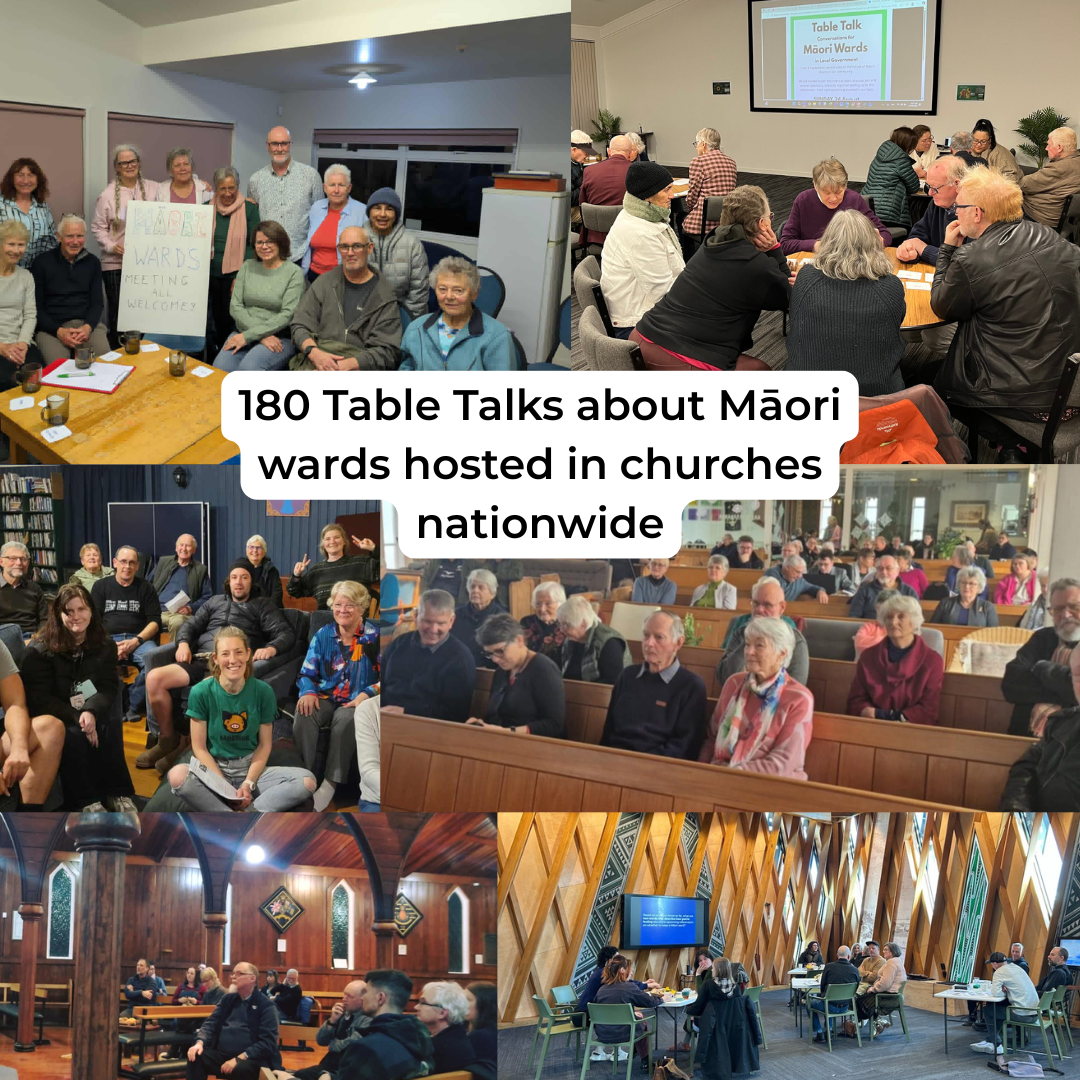
Our Common Grace Aotearoa team created ‘Table Talk’ resources to educate people about Māori wards in a safe space. Our Te Tiriti team mobilised to support churches to use these. The take-up was huge - across the country, 180 groups used these resources to run ‘Table Talk’ discussion evenings about Māori wards - representing thousands of people thinking deeply and prayerfully on this topic before they voted.
When the results came in, we had mixed feelings. Eighteen wards were kept, and twenty-four were lost, a saddening loss of Māori voices in decision-making. However, the result of these referendums revealed a shifting tide in our nation's heart. Across the nation, more people voted for Māori Wards than against them. That is a win!
When we compared results in areas that had held a referendum in the last ten years, we saw a 13% to 31% increase in support for Māori wards. In Whanganui, the District Council went from having zero Māori councillors last term, and only five in the last 150 years, to having two Māori councillors.
Despite the political rhetoric, the data points to Aotearoa moving towards a Te Tiriti-based future that values Māori representation. We are proud to be part of the movement nurturing that future.
Economic Justice: The Everyone Connected Campaign

In 2025, the cost-of-living crisis hit hard. For many in our communities, the simple act of turning on a heater or cooking a warm meal became a source of anxiety. We believe it shouldn’t be a privilege to have power or any other basic necessities.
Our Economic Justice campaign team worked tirelessly this year to reduce energy hardship. This group of dedicated volunteers embodies the heart of Common Grace: ordinary people doing extraordinary work.
In May, electricity prices were up 13% compared to the previous year, driven by decisions from the government, retailers, and lines companies. We were deeply concerned that these price rises would sweep thousands more households into poverty.
We took a two-pronged approach: pastoral care and systemic challenge.
In the lead-up to winter, we created an information leaflet titled ‘Struggling to pay your power bill?’. This resource was designed to help people learn how to negotiate cheaper plans and find support. It was a practical expression of manaakitanga.
We also demanded structural change. We wrote to power companies urging them to take proactive, compassionate steps to check customers were on the correct plans, offering discounts, and ending disconnection fees. Unfortunately, most companies chose not to take these steps, though we celebrate those who stepped up, like the non-profit Toast Electric, a non-profit provider centred on supporting low-income households, and Mercury Energy, which has almost stopped disconnections for non-payment.
Refusing to take "no" for an answer, we partnered with the NZ Herald. We conducted research to highlight which companies were failing their customers. Our findings made the front page, exposing that most companies do not proactively check if customers are on the cheapest plan, potentially leaving thousands paying more than they need to.
This public pressure worked.
We called on the Electricity Authority to intervene, and they listened. In November, they proposed new rules requiring power companies to proactively check customers’ plans every six months. To ensure this sticks, we mobilised a record level of public engagement to support the proposal.
Our goal remains clear: New Zealand must reach a point where no one is cut off from essential electricity because of poverty.
Upskilling in the Ministry of Transforming Unjust Structures
Common Grace Aotearoa exists to equip and organise followers of Jesus to run advocacy campaigns that advance policy solutions towards climate, economic and Te Tiriti justice.
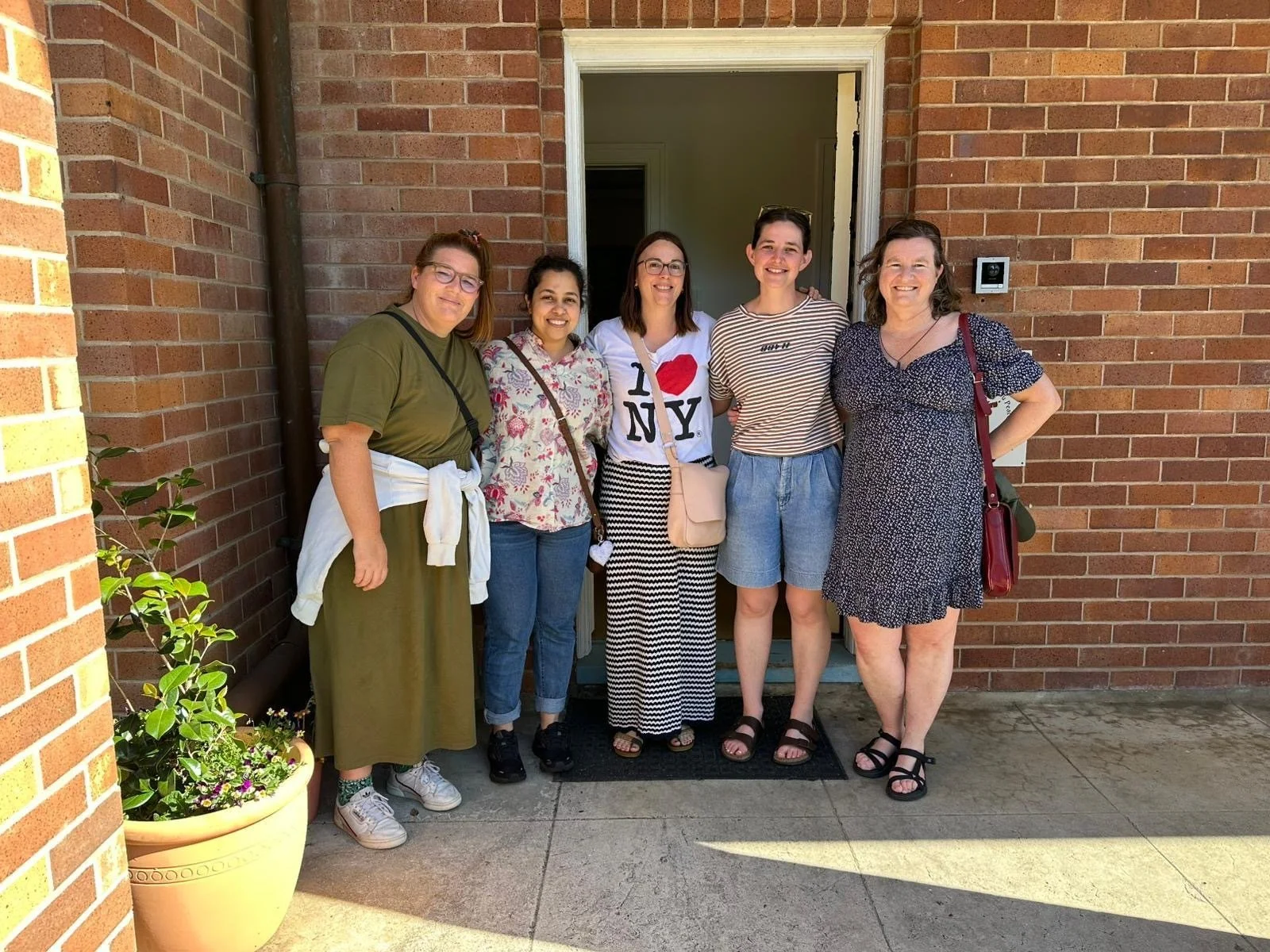
The core vehicle for our work is our four campaign teams, in which our Co-Directors mentor trainee advocates who ‘learn by doing’ as we make campaigns happen together. In 2025, we mentored 22 advocates, most based in Auckland and Wellington, who commit 5 hours per week to be involved.
You may have seen public moments in campaigns, such as the climate strikes, petitions or other calls to action. Our campaign teams make these moments happen by doing all the research, strategising and organising behind the scenes to build momentum for change.
In 2025, we piloted a new aspect of support for our campaign team members: a structured discipleship programme.
When we formed Common Grace in 2023, we observed that there were few, if any, discipleship pathways within the wider church for people with a heart for ‘transforming unjust structures in society’. The church was therefore not meeting its potential to transform unjust structures, grow holistic disciples or serve as a witness to the world.
While some of our campaign team members receive great input from their churches in the form of mentoring or small groups, some attended only Sunday services and did not have an intentional discipleship space where they could ask questions and receive deeper nurturing.
In 2025, we piloted a discipleship group to fill that gap. A group met fortnightly online. They found it deeply nourishing.
We hope to consolidate and deepen this programme in 2026 and expand it to include more of our volunteers.
We Need You for 2026
2025 has seen legislative shifts, media coverage, household savings, and prayers offered in public squares.
It might be easy to forget that this work is powered almost entirely by volunteers and on a shoestring budget.
We have a small team of part-time staff and a passionate army of volunteers like Gil, Esme, and the clergy who chained themselves to parliament buildings. We make a little go a very long way.
But the challenges of 2026 are already looming. The climate crisis is accelerating. The pressure on our most vulnerable families is not easing. And, there’s a general election! The need for a gracious, justice-seeking Christian voice in the public square is greater than ever.
We cannot do this without you.
Generous donors are the lifeblood of this movement. Every donation you make goes directly to sustaining this impactful work—printing leaflets, organising pilgrimages, researching policy submissions, and training advocates.
Will you join us?
Please consider joining our giving team by setting up a monthly donation or making a one-off gift to help us keep up the momentum. All donations are tax-deductible.
Together, let us continue to transform unjust structures. Let us continue to walk humbly, love mercy, and do justice.
Thank you for being part of this movement. Thank you for your passion, your prayer, and your action.